
HVAC Lead Generation Services: Why "Buying Leads" and "Generating Leads" Aren't the Same Thing

"HVAC lead generation services" gets used to describe two different products. One is a marketplace: you pay per lead, and someone else decides who gets it and how many other contractors see it too. The other is a marketing engine built around your business, combining ads, search visibility, and follow-up, that produces leads only you receive. Both are real, both work for different shops, and shopping for one while comparing prices from the other is how HVAC owners end up disappointed either way. This article breaks down how each model works, what the numbers say about response speed and lead quality, and how to figure out which one fits where your business is right now.
The two things people mean by "HVAC lead generation services"
When an HVAC company searches for lead generation services, they usually land on one of two very different offers.
The first is a lead marketplace or broker: pay a set price per lead (or per phone call), and a third party sends that lead your way. Some of these leads are shared, meaning the same homeowner's request gets sold to three or four contractors at once, and whoever calls back first usually wins the job. Others are sold exclusively, so you're the only contractor who receives it, at a higher price.
The second is owned lead generation. A company builds and runs the actual marketing (video ads, paid social, search content, or a combination) under your brand, and the leads that come in are yours from the start. Nobody else gets a copy of them. This is closer to hiring a marketing department than buying inventory. (See our take on hiring in-house vs. an agency for how that decision plays out in practice.)
Both get marketed under the same phrase, "HVAC lead generation services," which is why a Google search for that term surfaces marketplace sales pages, marketing-agency comparisons, and DIY tactic lists all mixed together. Before comparing prices, get clear on which of these two things you're buying.
How bought leads work (shared vs. exclusive)
If you go the marketplace route, the first decision is shared versus exclusive.
With shared leads, a homeowner fills out one form, and that request gets distributed to multiple HVAC contractors in the area, often three to five. You compete on speed and sales skill from the moment the lead lands, because whoever reaches the homeowner first usually gets the job. Shared leads are cheaper per lead, but a meaningful share of them go nowhere: the homeowner already booked with someone else, gave a fake number, or simply never answers a fourth call from a stranger.
Exclusive leads (sometimes sold as pay-per-call) cost more per lead, but you're the only contractor who gets it. Lead-gen vendors like Service Direct, who sell exclusive calls, report contact rates around 100% on exclusive calls versus roughly 25 to 30% on shared form leads, with booking rates to match: call it 50% booked versus closer to 10%. Take that specific figure as a vendor's own claim rather than independently audited research (Service Direct sells the product it's describing), but the general pattern, where exclusive leads convert meaningfully better than shared ones, lines up with what most contractors who've tried both will tell you.
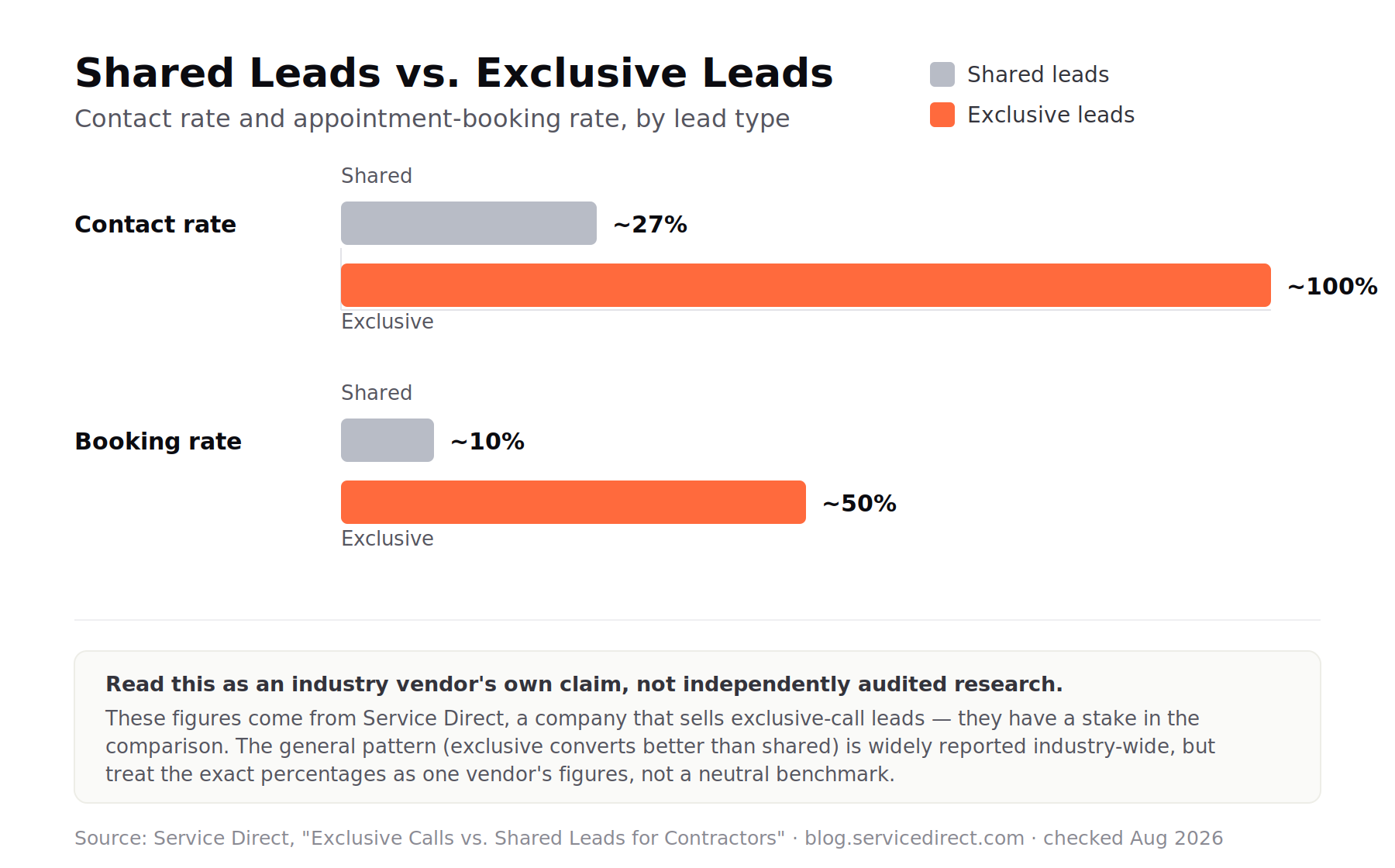
Neither model is a scam. Shared leads can still pencil out if your close rate and speed are strong and the cost per lead is low enough. Exclusive leads cost more up front but need less sales hustle to convert. The mistake is assuming "HVAC lead generation services" means one specific price point. It doesn't, and the shared or exclusive split is usually the single biggest lever on both cost and quality.
A middle tier also exists: capped-exclusive or "limited-share" leads, where a vendor caps distribution at two contractors instead of four or five. Pricing usually sits between shared and fully exclusive. Different vendors use different language for the same idea, so it isn't a standard industry term, and the only reliable way to know what you're buying is to ask directly: how many other businesses receive this exact lead, and at what point in the process does it get sent to them?
Questions worth asking before signing with a lead vendor
However a vendor markets its leads, a short list of direct questions cuts through most of the ambiguity:
- Is this lead shared, capped, or fully exclusive, and how many other businesses see it?
- What happens if the homeowner doesn't answer or the number is bad? Is there a refund or credit policy?
- Is pricing per lead, per call, or per booked appointment?
- Can you see a sample of the actual lead data (name, service requested, timestamp) before committing to volume?
None of this is unique to HVAC. The same due diligence applies to any pay-per-lead arrangement. HVAC's high average ticket size just makes a bad batch of leads more expensive to learn from than in lower-cost trades.
Why response speed decides who wins the lead, no matter where it came from
Whichever kind of lead you're working with, one variable matters more than almost anything else: how fast you call back.
The most cited research on this is a 2011 Harvard Business Review study by James Oldroyd, Kevin McElheran, and David Elkington, "The Short Life of Online Sales Leads." Studying tens of thousands of online sales leads across industries, the researchers found that the odds of successfully qualifying a lead dropped sharply with every passing minute after it came in, and fell roughly tenfold once an hour had passed. That study wasn't about HVAC specifically, since it looked at online leads broadly, but the underlying mechanism holds up across service businesses: a homeowner who just submitted a request is comparing options right now, not waiting patiently for a callback tomorrow.
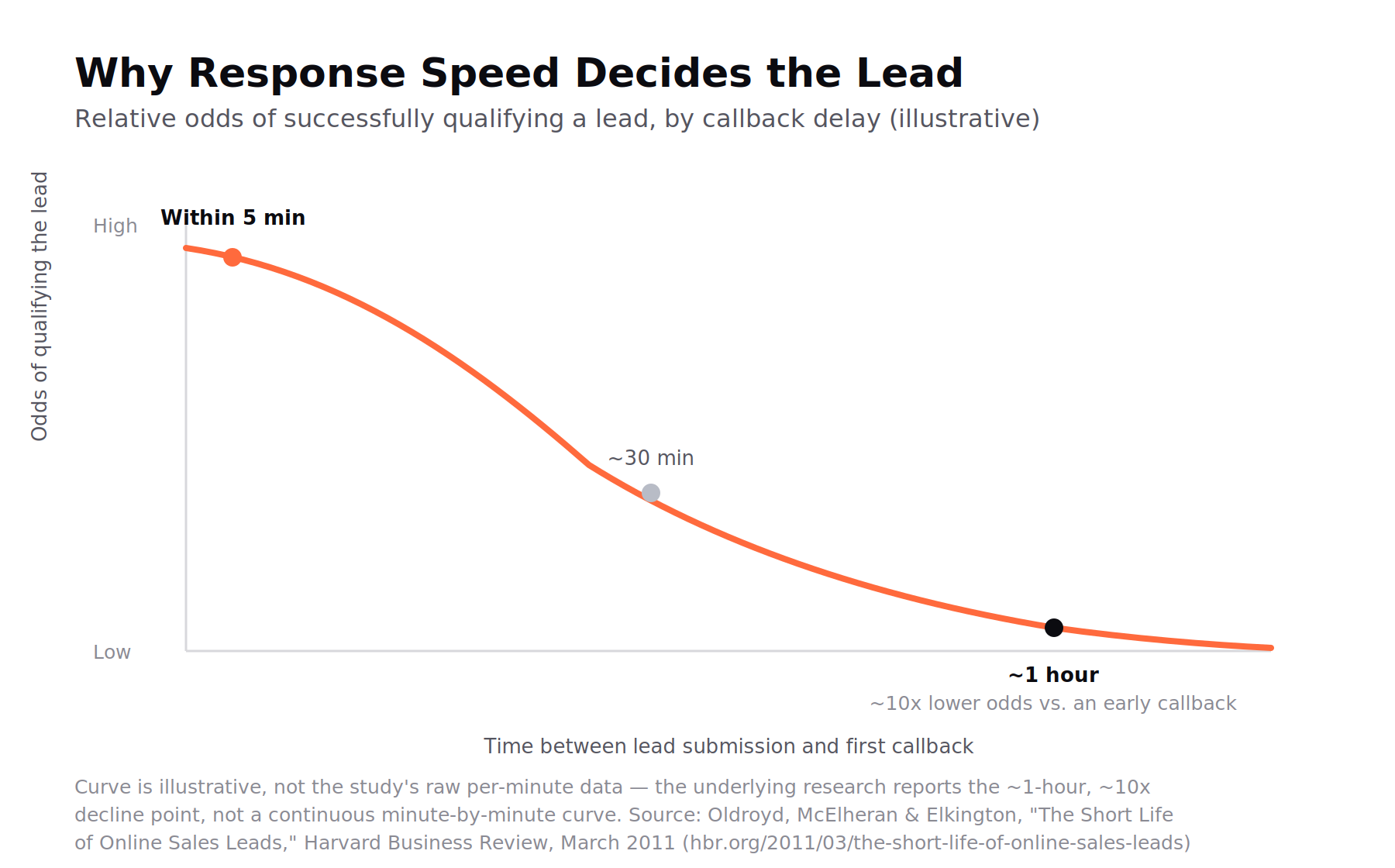
This is where the shared versus exclusive debate gets decided in practice. A shared lead isn't automatically a bad lead; it's a lead where four other contractors are racing you to the phone. If you call back in five minutes instead of two hours, you can out-convert a competitor sitting on better lead quality but slower follow-up. The reverse is also true: an exclusive lead you don't call for half a day has already lost most of its value, no matter what you paid for it.
Response speed is also the reason NovaReel treats lead generation as a callback problem, not just a traffic problem, which the section below covers.
Being specific about what "fast" means matters, because the numbers most businesses assume are too generous. "Fast" isn't the same day, and it usually isn't even the same hour, since the steepest drop in the Oldroyd/HBR data happens in the first several minutes. For an HVAC business, that means a lead coming in at 9pm on a Saturday from a Facebook ad needs the same urgency as one coming in at 9am on a Tuesday. Most in-house teams aren't staffed to do that consistently, which is less a failure of effort than a scheduling reality, because nobody wants a service advisor manning the phone at 9pm every night. That gap is why dedicated callback services exist as a layer on top of lead generation, rather than an in-house team trying to cover every hour a lead could come in.
What it costs to generate HVAC leads, by method
Costs vary a lot by method and market, but a few reference points help set expectations. Pay-per-lead marketplaces commonly charge $20 to $80 per shared lead, or well over $100 for exclusive calls in competitive metros, depending on job type and season. Google Ads clicks for HVAC rank among the most expensive in local services: NovaReel's own tracked data for "HVAC lead generation services" shows a CPC of $214.92 in the U.S. market as of August 2026, a useful live signal of just how much buyers will pay to be in front of someone searching this exact phrase. SEO carries little to no per-lead cost once a page ranks, but it takes months to build and doesn't respond to a slow sales quarter the way paid channels do. Paid social and video ad costs vary with creative quality and targeting, and generally sit below Google Ads CPCs for HVAC in most markets, with the tradeoff that the buyer wasn't actively searching, so the ad has to earn attention rather than answer a search.
For a broader industry reference point, WebFX's 2026 HVAC marketing benchmarks report puts average cost-per-lead around $153, with customer acquisition cost ranging $75 to $250 depending on channel, and typical marketing spend around 7% of annual revenue. One caveat, stated plainly: that figure blends WebFX's own client data with third-party tool estimates, not a trade-association or government survey, so treat it as one widely-referenced agency benchmark rather than a definitive industry number. Your actual costs will depend heavily on your market's competition and the season.
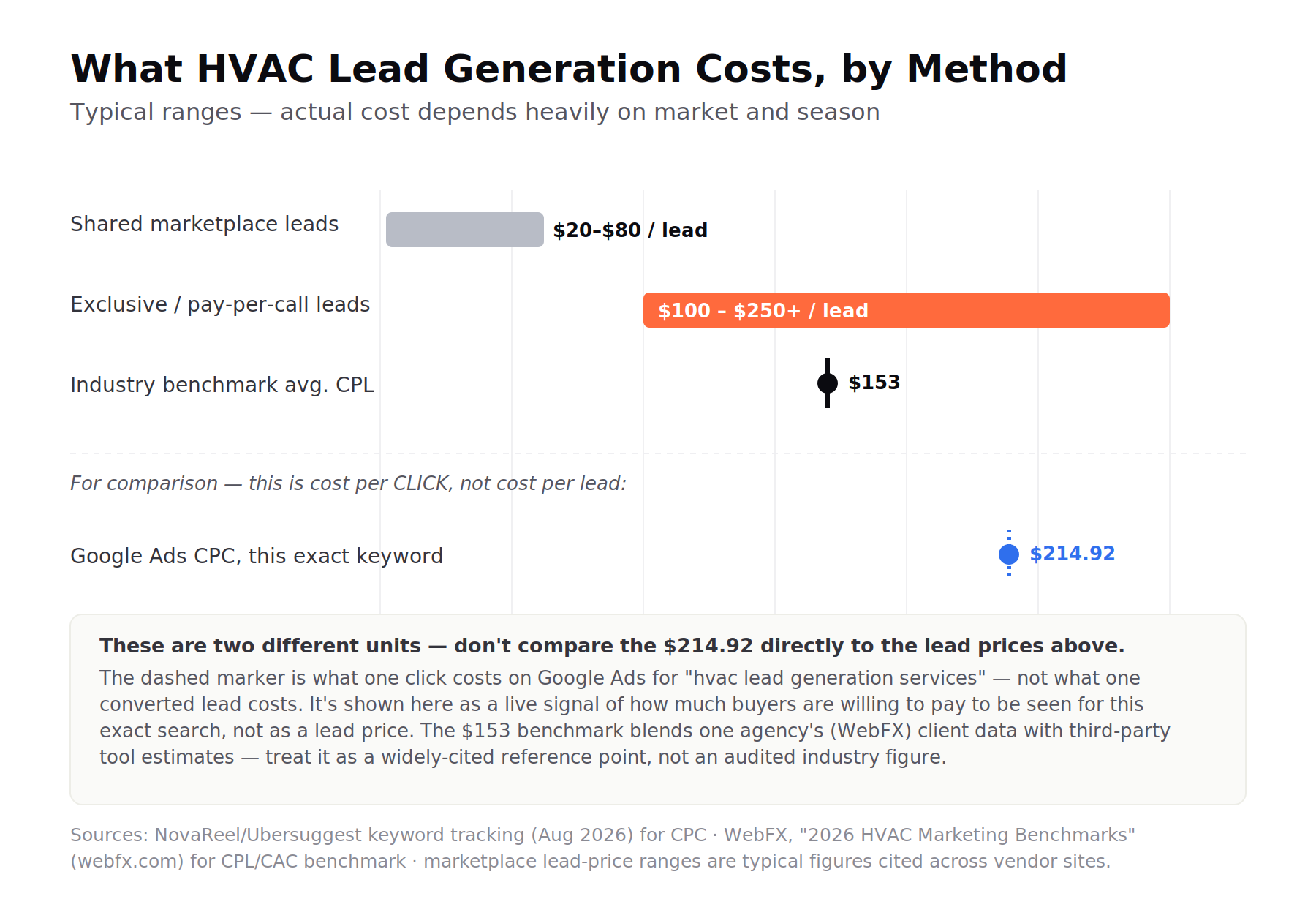
Two things tend to get missed when businesses compare these numbers side by side. First, cost-per-lead and cost-per-customer measure different things: a $40 lead that never answers the phone is more expensive, in real terms, than an $80 lead that books a job. Second, most of these costs move seasonally. HVAC search and ad costs typically climb in the weeks before the first real heat wave or cold snap of the season, when every contractor in a market bids for the same limited pool of homeowners searching at once. Locking in a marketing plan of any kind before that seasonal spike is usually cheaper than trying to buy your way into visibility once it's already underway.
Where video ads fit, and why NovaReel treats lead generation as a callback problem, not just a traffic problem
Video ads on Facebook and TikTok solve the top of this problem: getting your business in front of homeowners who need HVAC service, at a lower cost per impression than most search advertising, and with the kind of before/after or explainer content that builds trust before someone even calls.
But the Oldroyd/HBR research above points to where campaigns like this win or lose: what happens in the minutes after someone responds. A video ad can generate an excellent lead and still lose the job if nobody calls that homeowner back for three hours. NovaReel's own service is built to close that specific gap. Every lead that comes in from a campaign gets called back immediately and verified as a genuine, interested prospect before it reaches the HVAC business, rather than dropped into a queue. It's the same lesson the shared versus exclusive lead comparison teaches, applied to leads a business generates itself instead of buys: the lead source matters less than what happens in the first five minutes. (More on what to look for in a partner like this in our guide to choosing an HVAC marketing agency.)
How to decide which model fits your HVAC business
There's no single right answer. It depends on where your business is and what you're optimizing for.
If you need volume immediately and have the sales capacity to work through a lower contact rate, shared leads can be a reasonable stopgap, especially in a slow season. If you'd rather pay more per lead but spend less time chasing dead ends, exclusive leads are worth the premium. If your goal is a pipeline that gets more efficient over time and doesn't leave you dependent on a single vendor's lead supply, owned lead generation, meaning your own visibility through ads, content, and search, is the longer-term play, even though it takes more time to ramp up.
Most established HVAC shops end up using more than one of these at once: a marketplace for filling short-term gaps, and an owned marketing engine for building something that compounds. The question worth asking before buying anything labeled "HVAC lead generation services" is simply which of the two products above you're being sold, and whether that matches what you need right now.
A rough way to sort it: if cash flow is tight and you need jobs this week, shared or capped-exclusive leads make sense, accepting the lower contact rate as the tradeoff for lower upfront cost. If you have sales capacity but want fewer, better leads, go with fully exclusive leads or pay-per-call, even at a higher price per lead. If you're building for the next 12 or more months and want to stop paying per lead eventually, owned marketing under your own brand fits, even though it takes longer to show results than a marketplace purchase does. And if you're running ads already but losing jobs to slow follow-up, the gap usually isn't the ad or the lead source at all. It's what happens in the first few minutes after the lead comes in, which is worth fixing before spending more on generating additional leads.
FAQ
What is HVAC lead generation? It's the process of getting potential HVAC customers, meaning people who need repair, replacement, installation, or maintenance, into contact with your business. That can mean buying leads from a marketplace or building your own marketing (ads, SEO, referrals) that generates leads directly for your brand.
How much do HVAC leads cost? Shared leads commonly run $20 to $80 each; exclusive leads and pay-per-call can run well over $100 in competitive markets. Paid search and social ad costs vary by market and creative, with HVAC-related search terms among the more expensive keywords in local services advertising.
Are shared HVAC leads worth it? They can be, especially if your close rate and callback speed are strong and the per-lead cost is low. The tradeoff is lower contact and booking rates than exclusive leads, since multiple contractors are working the same request.
How do HVAC companies get leads without buying them? Through owned marketing: search engine optimization, paid social and video ads run under their own brand, referral programs, and reviews. These leads take longer to build up but belong to the business outright and don't compete against other contractors for the same homeowner.
Do shared HVAC leads mean the homeowner isn't serious? Not necessarily. Most homeowners submitting a shared-lead form genuinely want service; they just don't realize multiple contractors are about to call them. The effect is the same either way: whoever reaches them first, with a clear and confident pitch, has the advantage, regardless of how serious the homeowner was going in.
How long does it take for owned lead generation to start working? It varies by channel. Paid social and video ads can start producing leads within days of launch, since they don't depend on search rankings. Organic search content typically takes several months to gain traction, since it depends on a domain building up authority and trust with search engines over time, and no amount of spending shortcuts that ramp-up period.
Sources
- Oldroyd, J. B., McElheran, K., & Elkington, D. (2011). "The Short Life of Online Sales Leads." Harvard Business Review. https://hbr.org/2011/03/the-short-life-of-online-sales-leads
- Service Direct. "Exclusive Calls vs. Shared Leads for Contractors." https://blog.servicedirect.com/exclusive-vs.-shared-leads-for-contractors
- WebFX. "2026 HVAC Marketing Benchmarks." https://www.webfx.com/blog/home-services/hvac-marketing-benchmarks/