
HVAC Marketing Agency: What to Look For (and What NovaReel Delivers)
If you've called even one HVAC marketing agency, you already know the pitch: unlimited leads, guaranteed growth, a "custom strategy" that somehow sounds identical from company to company. What you rarely get on the call is a straight answer about price, timeline, or what happens if it doesn't work.
This guide skips the pitch. It's a checklist of what separates a good HVAC marketing agency from an expensive mistake, the red flags that should end a conversation immediately, and (since it would be strange to pretend otherwise) where NovaReel fits into that checklist. Read the criteria first. Decide for yourself where we land on them.
One quick clarification before the checklist: you'll see this same kind of company called an HVAC marketing agency, an HVAC advertising agency, or an HVAC digital marketing agency, depending on which service they want to emphasize. In practice they're describing the same work, so the checklist below applies no matter which term the agency (or your own search) uses.
What does an HVAC marketing agency actually do?
Strip away the jargon and an HVAC marketing agency does one or more of five things: search engine optimization (getting your site to rank when someone searches "AC repair near me"), pay-per-click ads (paying for that same visibility instantly instead of waiting months to earn it), website design, review and reputation management, and, increasingly, paid social and video ads on Facebook, Instagram, and TikTok. Most agencies bundle two or three of these into a monthly retainer rather than selling them individually.
What makes HVAC different from a generic "local business marketing" package is timing. Demand for HVAC service doesn't move evenly through the year. It spikes hard, in both directions, and an agency that doesn't plan around that wastes your budget for half the year. Seasonal search data from WebFX puts numbers on what most HVAC owners already feel: AC repair searches peak in July at roughly 91,690 monthly searches and bottom out in February around 25,027, a 266% swing. Heating repair runs the opposite direction, peaking in January (~62,392 searches) against a May low of ~26,378. Emergency AC repair searches (the "my AC just died and it's 95 degrees" kind) show the widest swing of all: 393% variance, peaking in November when systems that limped through summer finally give out.
A generic marketing agency misses that pattern and an HVAC-specific one shouldn't. Our recommendation: start ramping campaigns 30 to 45 days before the seasonal spike, not during it. That's NovaReel's own guidance based on how our campaigns behave, not an industry-published benchmark. An agency running your cooling ads the same way in February as they do in July isn't being consistent; they're being lazy.
What HVAC marketing pricing actually breaks down into
The $5,000-to-$12,000 range in the FAQ below isn't one flat number. It's four tiers with different deliverables behind each one. Per Sure Shot Systems' 2026 pricing guide, the rough breakdown looks like this:
| Tier | Monthly range | What's typically included |
|---|---|---|
| Essentials | $5K–$7K | PPC in 2–3 service categories, core on-page SEO, 1–2 content pieces, call tracking |
| Growth | $8K–$12K | Heavier media management, landing-page testing, 3–4 content pieces a month, lead-source reporting |
| Enterprise | $15K–$25K+ | Dedicated strategists, ongoing creative production, compliance-grade reporting |
| Performance hybrid | Base + incentive | Reduced retainer plus $300–$800 per qualified lead, or 8%–15% of closed revenue |
One caveat worth stating plainly: that guide is written for commercial and B2B HVAC contractors chasing plan-spec and design-build bids, not the residential service calls most HVAC companies run day to day. Treat the tier structure as directional, showing what changes as the price climbs, rather than an exact quote for a five-truck residential shop. For that segment, the dollar range lands closer to the $5K–$10K figure DollarPocket's independent pricing study found for comparable small-business retainers, which is why the FAQ below cites both.
Retainer vs. performance-based: how the pricing structure changes the risk
Two agencies quoting a similar monthly number can be selling very different deals, depending on what's fixed and what moves.
A flat retainer means you pay the same amount whether the agency delivers 8 leads that month or 30. You get cost predictability. The agency carries the upside and downside of how well the campaigns actually perform.
A performance hybrid flips part of that. A common structure: a reduced base fee, often 40% to 60% of what a full retainer would cost, plus a per-lead or per-booked-job bonus on top. Run the math on a $10,000 full-retainer equivalent: a $5,000 base plus $400 per qualified lead means you'd pay $8,200 for 8 leads or $11,000 for 15. You're covered if the month is slow, and the agency has a direct incentive to bring in more than the bare minimum.
The tradeoff is in the definitions. "Qualified lead" has to mean something specific: a real phone number, an actual service area, some sign of near-term intent, or the whole structure falls apart. Ask what happens to a bad lead, whether there's a cap on how many the agency gets paid for in a month, and whether there's a clawback if a "lead" turns out to be a wrong number or a duplicate. An agency that won't put a lead definition and a cap in writing is one where the performance-based pitch sounds better than it actually protects you.
7 things to actually evaluate before you sign
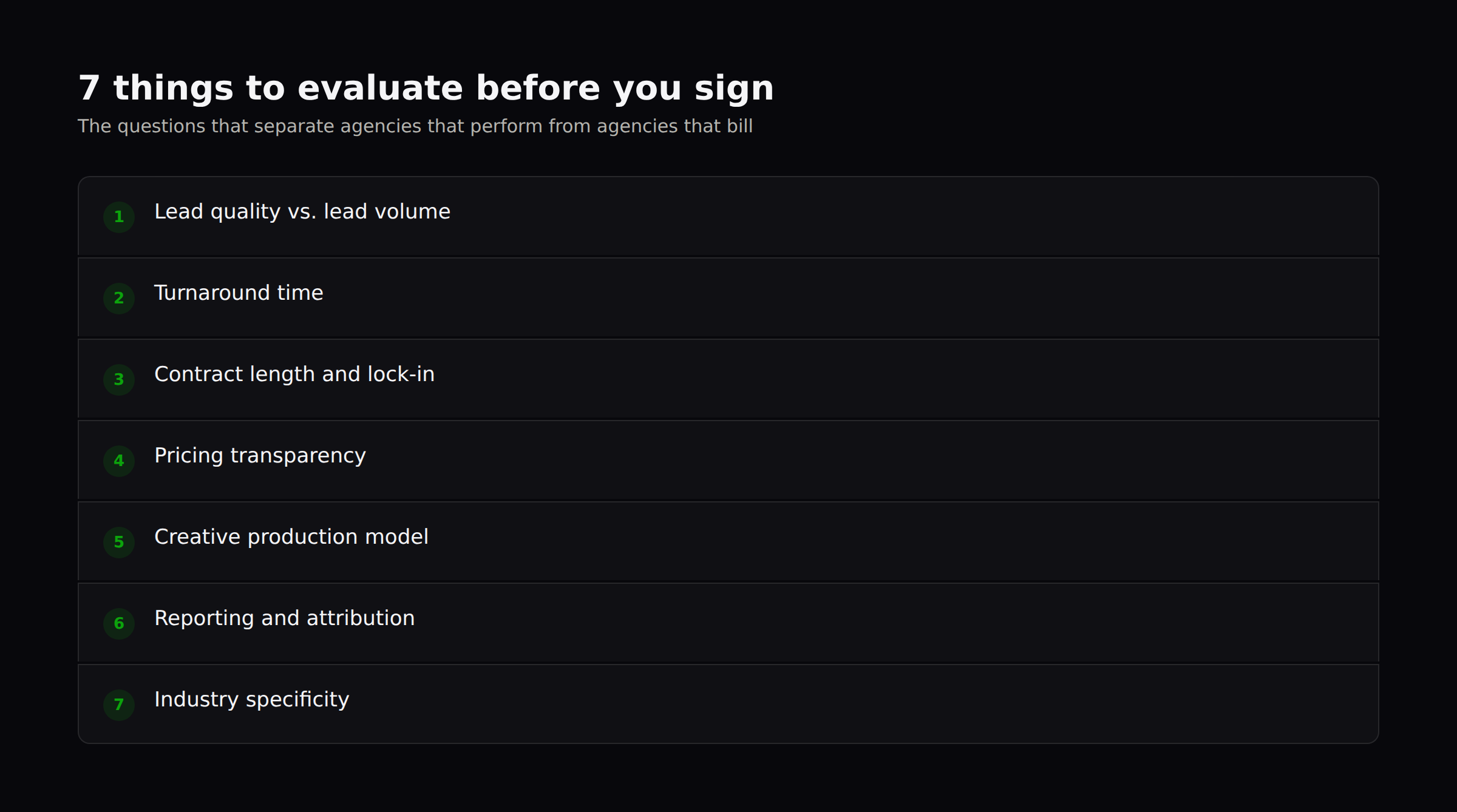
Every agency's sales page says some version of "we're different." The way to tell is to ask about these seven things specifically, not because they're a NovaReel talking point, but because they're the questions that separate agencies that perform from agencies that bill.
Picture a mid-size HVAC company. Call him Ray, a composite of the shop owners we talk to regularly rather than a specific client, running five trucks and looking to replace an agency that's been coasting on autopilot. Ray's story below isn't a case study. It's a stand-in for the conversation almost every HVAC owner in this position eventually has.
| What to check | Why it matters | The question to ask |
|---|---|---|
| Lead quality vs. lead volume | 40 "leads" a month means nothing if 30 are wrong numbers or people who already booked someone else | "Do you verify or call back every lead before I see it, or do I get the raw list?" |
| Turnaround time | A slow agency can't react to a heat wave, a competitor's ad, or a sudden gap in your schedule | "If I need a new ad live this week, what's your actual turnaround?" |
| Contract length and lock-in | Month-to-month means the agency has to keep earning your business; a 12-month lock-in means they don't | "What happens if I want to cancel in month two?" |
| Pricing transparency | "Request a free audit" is often a way to avoid publishing real numbers | "Can you give me an actual price range right now, on this call?" |
| Creative production model | Filmed-on-site content looks the most authentic but is the slowest and most expensive to produce; template/stock content is fast but forgettable | "Is my ad creative filmed, AI-assisted, or templated, and how fast can you turn a new one around?" |
| Reporting and attribution | Impressions and clicks are not the same as a booked job | "Can you show me which specific ad produced a specific booked job, not just traffic?" |
| Industry specificity | A generalist "local services" agency running the same playbook for a plumber, a roofer, and an HVAC company is not accounting for your seasonality | "How does your strategy change between my slow season and my peak season?" |
Ray's old agency failed exactly two of these, lead verification and pricing transparency, and that was enough to lose his trust in everything else they said, fairly or not. That's usually how it goes: one unanswerable question on this list makes a buyer suspicious of every other claim the agency makes.
Red flags that mean walk away
Some of these overlap with the checklist above, but they deserve to be called out on their own, because they should end the conversation immediately rather than just get flagged as a concern:
- Vague or undisclosed pricing. "It depends" is a fine first answer. "We don't share pricing until after a strategy call" is not; that's a sales-process choice, not a business necessity.
- Long lock-in contracts with early-termination fees. If an agency is confident in its results, month-to-month shouldn't scare them.
- No case studies with real numbers. "We helped a client grow" isn't a case study. A specific before/after with real, checkable numbers is.
- "We'll optimize your SEO" with no specifics. Optimize what, exactly? Ask what pages, what keywords, what's changing. A real answer sounds like a plan; a vague one sounds like a script.
- Leads that are never called back or verified before being sent to you. This is the single most common way HVAC owners get burned: paying for volume instead of quality, with no one checking the leads are real before you're billed for them.
What NovaReel delivers against this checklist
Below is where NovaReel's video ad production and campaign management for HVAC contractors sits against the same seven criteria, not because every agency should be judged against us, but because it would be dishonest to write this whole checklist and then dodge applying it to ourselves.
We call back and verify every lead before it reaches you, so you're not paying to sort through a raw list yourself. The contractors we work with also get free, embeddable tools, such as our HVAC repair or replace calculator, which you can drop straight onto your own site to give homeowners a reason to stay on your page instead of a competitor's.
Video ad creative goes from brief to live campaign in 48 to 72 hours, without filming. That's the biggest structural difference between NovaReel and a traditional agency, which typically has to schedule a shoot, wait on footage, and edit before anything goes live.
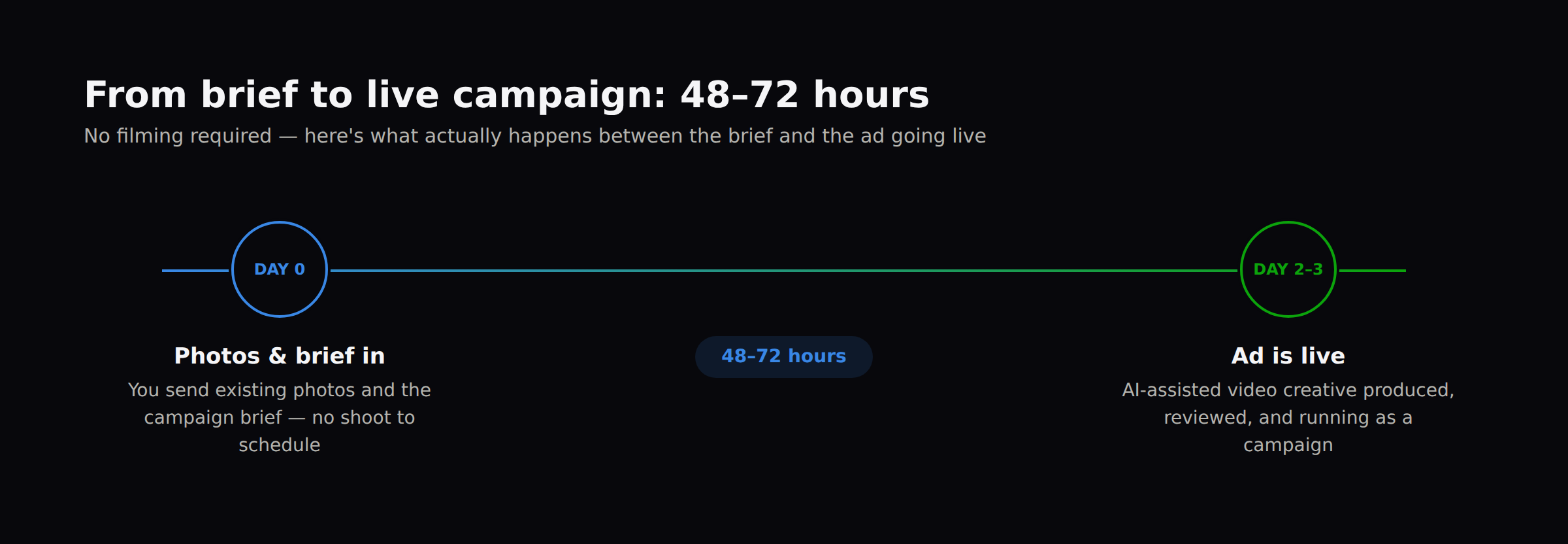
Our creative production model is AI-assisted video, built from photos and a brief rather than a camera crew on-site. That's what makes the 48 to 72 hour turnaround possible, and it's a real tradeoff: you give up the filmed, fly-on-the-wall documentary feel in exchange for speed.
Contracts are month-to-month with no long-term lock-in, and current pricing and campaign performance sit directly on the NovaReel site rather than behind a "book a call" form.
We plan campaigns around HVAC's actual seasonal curve, using the same kind of seasonality data covered above, instead of applying a generic "always-on" strategy to every vertical.
What we're not claiming: we're not a full-service SEO agency, and we don't build or manage your website. If what you need is organic search ranking work specifically, that's a different kind of agency than what we do, and we'd rather say so than stretch to sound like we cover everything.
What results actually look like (and how to sanity-check any agency's numbers)
Back to Ray for a second. When his old agency said "results in 30 days," what they meant, though they never said it this plainly, was "your ads will be live in 30 days," not "your phone will be ringing in 30 days." That gap between "campaign launched" and "results showing" is where a lot of HVAC owners feel misled, even when no one technically lied to them.
For organic SEO specifically, WebFX's published timeline data puts real results at three to six months on average, sometimes up to a year, with the first two months mostly spent on research, audits, and technical fixes rather than anything a customer would notice. That's not a NovaReel number; it's a general SEO industry benchmark, and it's worth knowing whether the timeline an agency quotes you sounds like that or sounds like a sales promise. Paid channels (PPC and paid social/video) move faster, since you're paying for placement rather than earning it, but "faster" still means weeks of testing and optimization, not days.
The sanity-check works the same way regardless of which agency you're evaluating:
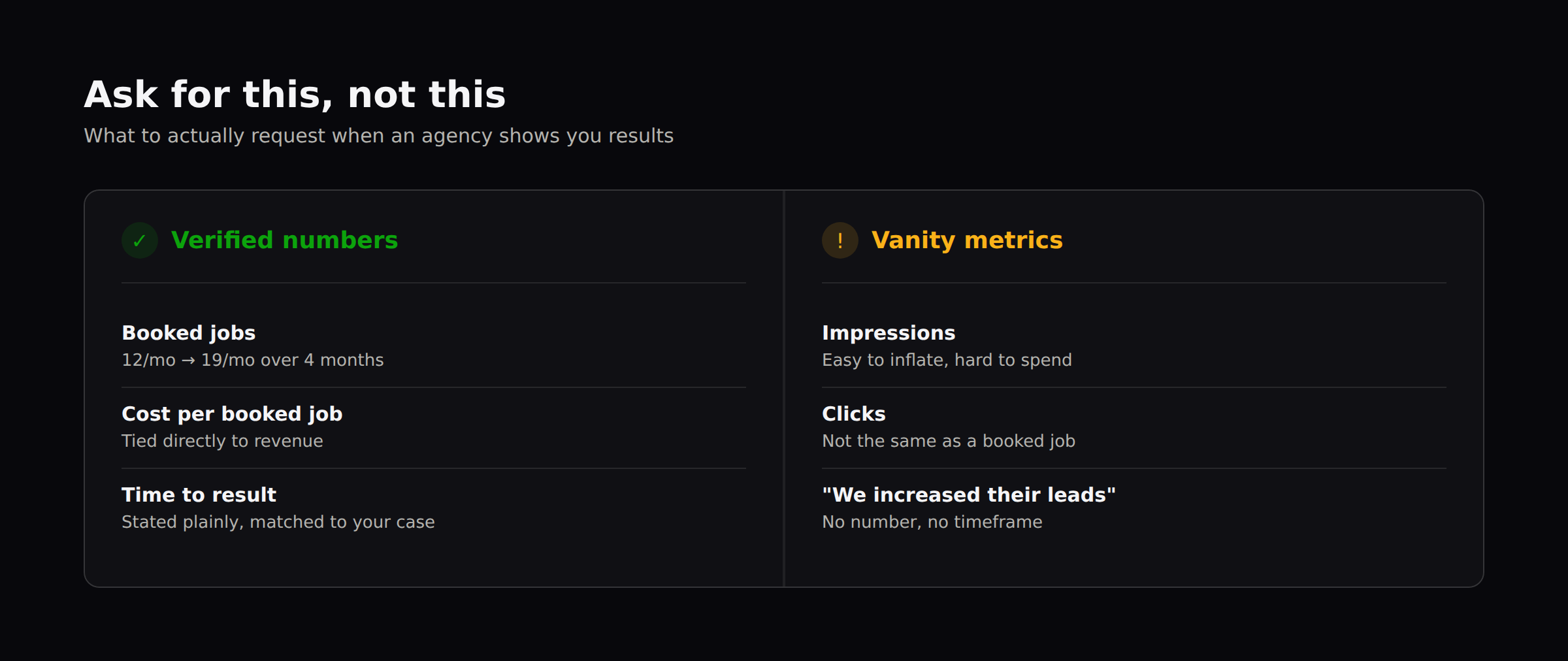
- Ask for a specific before/after number, not a description. "We increased their leads" is not a number. "Their booked jobs went from 12/month to 19/month over four months" is.
- Ask what the number is measuring. Impressions and clicks are the easiest numbers to make look impressive and the least connected to your actual revenue. Booked jobs and cost-per-booked-job are what count.
- Ask how long that result took, and compare it to the timeline they're quoting you. If a case study took eight months and they're promising you results in three weeks, ask why yours would be faster.
None of this is about distrust for its own sake. It's that "trust us" is not a business plan, and any agency worth hiring should be comfortable being asked to show their work.
FAQ
What does an HVAC marketing agency typically cost? Published pricing across the industry generally lands between $5,000 and $12,000 per month for a small-to-midsize HVAC contractor, based on cross-referencing Sure Shot Systems' 2026 pricing guide ($5K to $12K/mo, tiered by contractor size) against an independent pricing study from DollarPocket ($5K to $10K/mo for comparable small-business retainers). Both sources are agency-adjacent content, not an audited third-party study, and nobody publishes rigorous independent research on this specific niche. Treat $5K to $12K as a reasonable planning range, not a guaranteed quote, and get an actual number in writing before committing.
Is hiring an HVAC marketing agency worth it for a small or family-owned company? It depends less on company size than on whether you have the time to run marketing well yourself. A small, family-run shop often doesn't have anyone whose job is to watch ad performance daily, adjust seasonal spend, or keep a website current, which is exactly the gap an agency (or a focused tool like a video-ad service) is meant to fill. The math that matters isn't "can I afford an agency," it's "what's the cost of my own time spent doing this instead of running jobs."
How long before HVAC marketing campaigns produce results? For organic SEO, three to six months on average, per the WebFX data cited above. For paid ads (PPC or paid social/video), results, meaning actual traffic and lead flow rather than just campaign launch, typically show within the first few weeks, though the campaign still needs several weeks of real data before it's optimized rather than just running.
What's the difference between HVAC marketing and general local-service marketing? Mainly seasonality and search intent. A landscaper's demand ramps up gradually with the seasons; HVAC demand can spike within days of a heat wave or cold snap, with a large share of that demand being emergency, ready-to-book searches rather than research-phase browsing. An agency built for general local services can still do fine work, but one that's planned specifically around HVAC's demand curve, pre-positioning cooling campaigns before summer and heating campaigns before winter, starts from a real advantage.
Do I need a contract, or can I go month-to-month? Most reputable agencies now offer month-to-month options. It's become enough of an expectation that agencies advertising "no long-term contract" do so because buyers specifically ask for it. Treat a long mandatory lock-in as a question worth pushing on, not a standard term to accept.
Does it matter if my HVAC marketing agency is "near me"? Less than it used to. Searching for an "HVAC marketing agency near me" makes sense if you want in-person meetings or someone who knows your specific city's competitive market. But digital marketing work itself (ad creative, campaign management, SEO) doesn't require physical proximity the way an actual HVAC repair does. NovaReel works remotely with HVAC contractors regardless of location, which is worth knowing before you narrow your search to a shortlist based on zip code alone: local isn't a requirement, it's a preference some owners have.
Is an "HVAC advertising agency" different from an "HVAC digital marketing agency"? Not meaningfully. Some companies use "advertising agency" to emphasize paid media (PPC, paid social) over organic SEO, and "digital marketing agency" as a broader umbrella term, but in practice most HVAC-focused shops offer some mix of SEO, PPC, and paid social regardless of which term is in their name. Use the checklist above rather than the label on their homepage to evaluate them.
Related reading: if you're not sure whether to hire an agency at all versus building this out in-house, see marketing an HVAC company: in-house vs. agency for the real salary and retainer cost breakdown.