
Marketing an HVAC Company: Should You Hire In-House or an Agency?
Most HVAC owners face this decision exactly once and then live with it for years: hire someone to run marketing in-house, or hand it to an agency. Both options work. Both also fail constantly, usually for the same reason: nobody compared what each one actually costs before committing. This is that comparison, with real numbers instead of vague reassurance.
One disclosure worth stating plainly: NovaReel is an HVAC marketing agency, so this comparison isn't from a neutral bystander. The numbers throughout are pulled from outside sources and cited so you can check them yourself.

What "marketing an HVAC company" actually involves
Before the cost comparison makes sense, it helps to be specific about what the job covers. Modern HVAC marketing isn't one task. It's at least five running at once: local SEO (showing up organically when someone searches "AC repair near me"), Google Business Profile management, paid search and Local Services Ads, paid social and video ads on Facebook, Instagram, and TikTok, and ongoing review generation. Email marketing and direct mail round it out for companies that use them.
That's the honest answer to "how do you market an HVAC company": not a single tactic, but a channel mix that has to run continuously, adjust for season, and get measured well enough to know what's working. Whoever owns this job, one hire or a whole agency team, is signing up to run all of it, not pick a favorite channel and hope.
The real cost of an in-house marketing hire
A single in-house hire sounds like the cheaper option, and on paper, it often is, at least at first glance. The real number is higher than most owners budget for, because one person is being asked to do a specialist team's job.
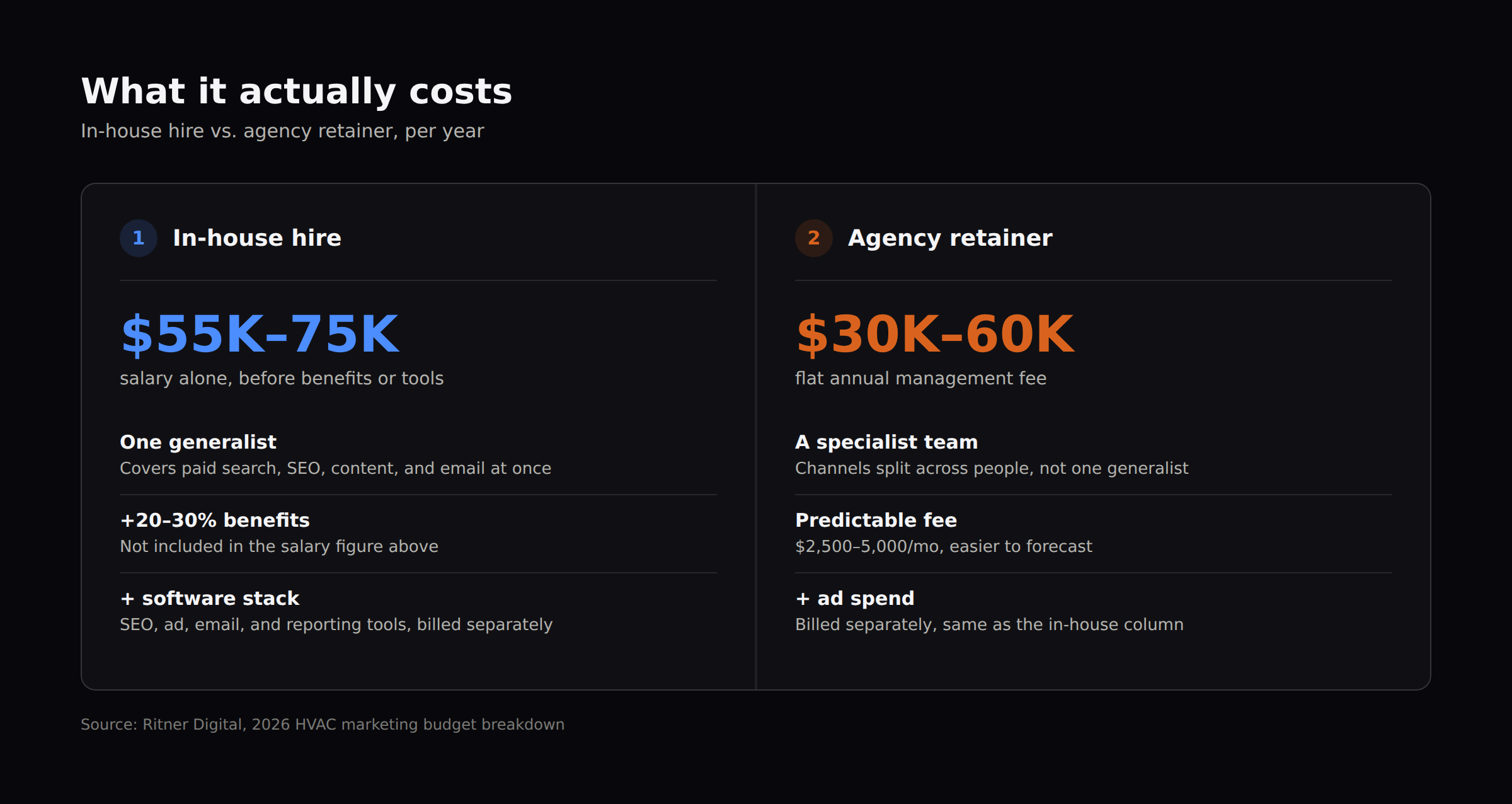
According to Ritner Digital's 2026 HVAC marketing budget breakdown, "a single in-house marketing person with the skills to manage paid search, local SEO, content, and email costs $55,000 to $75,000 in salary alone — before benefits, tools, and training." That last part matters: benefits typically add 20 to 30% on top of salary, and the software stack alone (SEO tools, ad platforms, email tools, reporting dashboards) is a real recurring line item most first-time hiring plans miss entirely.
For broader context, the U.S. Bureau of Labor Statistics reports a median annual wage of $161,030 for marketing managers as of May 2024, across industries. That figure runs well above the HVAC-specific number above, and it makes sense why: it covers the broader "marketing manager" title across industries generally, which skews toward larger companies and more senior scope than the generalist role most HVAC companies are hiring for. The Ritner Digital figure is the more directly relevant one for this decision, but the gap between the two is worth knowing, because it's roughly the gap between "a generalist doing their best across five channels" and "a specialist team," which is exactly the tradeoff this whole comparison comes down to.
The real cost of an HVAC marketing agency
The agency side of the comparison is more predictable, because it's usually a flat monthly fee instead of a salary-plus-everything-else calculation.
Per the same Ritner Digital breakdown, "a good boutique agency serving HVAC companies at your revenue level charges $2,500 to $5,000 per month in management fees," or $30,000 to $60,000 a year. That's less than the in-house salary range above, and for that fee you're getting a team of specialists split across channels instead of one person covering all of them. The tradeoff: that monthly fee usually doesn't include ad spend itself (the money going to Google or Meta for clicks and impressions), which is billed separately either way, in-house or agency.
What top-performing HVAC companies spend on marketing, total
Both options above have to fit inside a real ceiling: what the business can afford to spend on marketing as a whole, agency fee or salary plus ad spend included.
Built on Tenth's 2026 HVAC marketing benchmarks found that top-quartile HVAC companies allocate 6% to 9% of gross revenue to marketing. Counterintuitively, bottom-quartile companies spend more as a percentage of revenue (10 to 18%) while getting worse results, typically from weak channel selection and no real measurement of what's working. The same research found that top performers hold customer acquisition cost below $350 and review cost-per-booked-job on a weekly basis, not quarterly or "whenever someone gets around to it."
The practical takeaway: the in-house-vs-agency decision isn't really about picking the cheaper line item. It's about which structure gets you closer to that 6-9% top-performer range with a real cost-per-booked-job number attached to it, rather than the 10-18% bottom-quartile range with no idea what's working.
What each option is good at
| Category | In-house hire | Agency |
|---|---|---|
| Speed/turnaround | One person, sequential work, can't run five things in parallel | A specialist team can move on multiple channels at once; some agencies, including NovaReel, run video ad turnaround in the 48-72 hour range specifically because production isn't sitting on one person's desk |
| Channel breadth | Realistically strong at 1-2 channels, weaker everywhere else | Specialists per channel, though that comes with less deep institutional knowledge of your specific business |
| Institutional knowledge | Knows the trucks, the techs, the seasonal patterns, without a briefing | Has to be briefed and kept current, a real cost, not just an inconvenience |
| Cost predictability | Salary is fixed, but benefits, tools, and training add up and are easy to under-budget | Flat monthly retainer, easier to forecast, but ad spend is still a separate variable either way |
| Accountability | Easy to redirect day-to-day priorities immediately | Slower to redirect mid-retainer, though a month-to-month contract fixes most of this |
Neither column is the "right" answer by default. A company already close to the top-performer 6-9% marketing spend, with a genuinely capable in-house hire covering their strongest channel, can do fine without an agency. A company spending more than that and still not sure what's working is usually the one an agency's specialist coverage and better reporting discipline can fix.
Signs it's time to switch, either direction
Signs an in-house hire has outgrown their capacity: a channel that's obviously missing (no paid social, no video ads, whatever the current hire hasn't gotten to), lead volume that's plateaued for more than a quarter with no clear next test to run, or a hire who's stretched too thin to try anything new during peak season, which is exactly when new tests matter most.
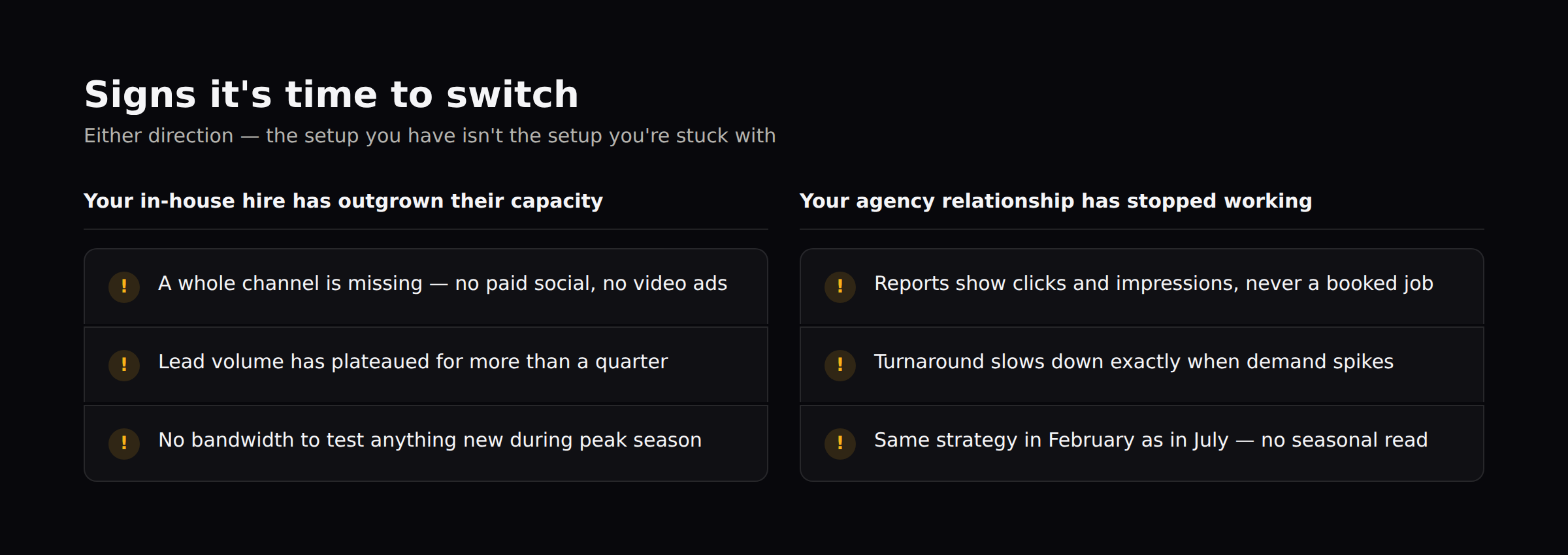
Signs an agency relationship has stopped working: reporting that shows clicks and impressions but never a specific booked job tied to a specific ad, turnaround that's slower during a heat wave or cold snap than it is the rest of the year, and a strategy that reads the same in February as it does in July, a real sign the agency isn't accounting for HVAC's seasonal demand curve at all. If you want the fuller checklist for vetting a marketing agency specifically, see what to look for in an HVAC marketing agency. The criteria there (lead verification, contract terms, pricing transparency) apply directly to deciding whether to switch, not just whether to hire one in the first place.
FAQ
How much does it cost to market an HVAC company? Total spend, in-house or agency, typically lands in the 6-9% of gross revenue range for top performers, per the Built on Tenth benchmark cited above. Companies spending 10-18% of revenue tend to be the ones without a clear read on what's working, not the ones getting better results for the extra spend.
Is it cheaper to hire in-house or hire an agency? It depends on scale, but the raw numbers above lean toward agency being the lower-cost option for most small-to-mid HVAC companies: $30,000-$60,000/year for a specialist team vs. $55,000-$75,000+ in salary alone for one generalist, before benefits and tools. Below a certain size, though, a single capable in-house hire focused on one or two channels can still make sense. That's not a hard rule, just where the numbers point on average.
What does an HVAC marketing agency actually do, day to day? Covered in full in what to look for in an HVAC marketing agency. The short version: some combination of SEO, paid search, paid social/video ads, website management, and reputation management, usually bundled into a monthly retainer.
Can a small HVAC company do its own marketing with no hire and no agency? At very small scale, yes. A Google Business Profile kept current, a handful of Google reviews requested after every job, and a simple website cover a lot of ground before either a hire or an agency is necessary. The tradeoff is time, not money: someone at the company is still doing the work, just without dedicated hours for it, which tends to show up as inconsistency once the business gets busy.